
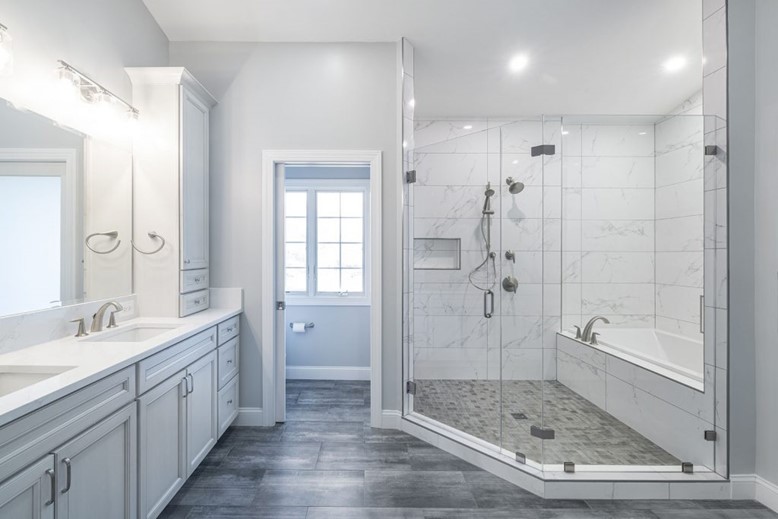

For decades, bathroom floor design relied heavily on standard square tiles or intricate mosaic patterns. While these options offered reliable functionality, they often left homeowners and designers wrestling with a web of grout lines that disrupted the visual flow of the room. Today, a major design shift is underway. Large format tiles have moved from commercial lobbies and luxury hotels straight into residential bathrooms, completely altering how these intimate spaces are designed, perceived, and maintained.
By definition, large format tiles are any tile options that feature at least one edge measuring 15 inches or longer. The most common residential floor sizes have surged to 24 by 24 inches, 24 by 48 inches, and even massive porcelain panels that stretch up to several feet across.
When implemented on a bathroom floor, these expansive surfaces do much more than follow a temporary minimalist trend. They structurally transform the spatial dynamics, hygiene profiles, and overall value of a home.
The Illusion of Expansive Space
One of the most powerful reasons designers select large format tiles for modern bathrooms is their ability to trick the human eye into perceiving a room as much larger than its actual physical dimensions.
Bathrooms in typical residential layouts are often tightly contained spaces constrained by plumbing lines and architectural footprints. When you cover a compact floor with small tiles, you introduce a dense grid of intersecting grout lines. This grid acts as a visual map of boundaries, forcing the eye to stop at every individual square and constantly reminding the brain of the room’s limited size.
Large format tiles achieve the exact opposite effect. Because a single tile covers a vast surface area, the number of grout joints required drops by a massive percentage. The eye glides across the floor without interruption. This lack of visual noise creates a continuous plane that expands the perceived boundaries of the floor, giving even a modest master bathroom a grand, open feel.
When these oversized tiles are paired with rectified edges, which are perfectly square, machine-cut edges that allow for microscopic grout joints, the lines practically disappear. Homeowners can select a grout color that perfectly matches the base tone of the tile to achieve a nearly seamless monolithic surface.
Revolutionizing Bathroom Hygiene and Maintenance
While the aesthetic upgrade is undeniable, the practical benefits of large format tiles on a bathroom floor are arguably even more compelling. The bathroom is the highest humidity zone in any home, making it the primary battleground against mold, mildew, and moisture damage.
Grout is inherently porous. It is composed of a cement-based mixture that, even when sealed, contains microscopic holes capable of absorbing water, soap scum, skin oils, and airborne bacteria. Over time, these elements combine to cause discoloration, staining, and persistent fungal growth. Scrubbing grout lines with harsh chemical cleaners is one of the most detested residential maintenance chores.
By shifting to large format options, you eliminate up to 80 percent of the grout joints on your floor. Less grout directly equates to fewer environments where mold can take root. Cleaning a large format tile floor is remarkably straightforward, requiring nothing more than a quick wipe down with a flat microfiber mop and a neutral cleanser. The smooth, non-porous glazed surface of high-quality porcelain or ceramic resists deep stains, ensuring that the room remains genuinely sanitized with a fraction of the physical effort.
Achieving the High-End Slab Aesthetic Safely
Historically, achieving a seamless, unbroken stone look on a floor required purchasing massive slabs of natural solid marble, granite, or quartzite. Solid stone slabs are incredibly heavy, require structural subfloor reinforcement, demand constant sealing, and come with an astronomical price tag that puts them far out of reach for standard remodeling budgets.
Modern manufacturing techniques have bridged this gap through ultra-durable porcelain engineering. Today’s large format porcelain tiles feature high-definition digital inkjet printing that flawlessly replicates the intricate veining of Calacatta marble, the rugged texture of split slate, or the industrial coolness of poured concrete.
Because these designs are printed across large expanses, the patterns feel organic and varied, avoiding the repetitive stamp effect often seen with smaller, cheaper alternatives. This gives homeowners access to the elite aesthetic of solid natural stone without the structural weight or the delicate maintenance liabilities. Porcelain is highly resistant to cracking, scratching, and chemical fading, making it an ideal long-term investment for a high-moisture floor.
Critical Installation Realities
Transitioning to large format tile is not as simple as swapping out boxes of materials. The installation process demands specialized tools, unique materials, and a level of precision that far exceeds traditional tiling methods. Understanding these technical requirements is essential for a successful project.
-
Subfloor Flatness: This is the absolute most critical factor. Standard tiles can tolerate minor dips and crowns in a subfloor because the installer can adjust the mortar bed thickness over short distances. Large format tiles have no flexibility. If there is a variation of more than one-eighth of an inch over a ten-foot span, the stiff tile will bridge the gap, leaving a hollow void underneath or causing the edges to stick up past the adjacent tiles, an industry problem known as lippage. Installers must use self-leveling underlayment compounds to prep the floor before a single tile is laid.
-
Mortar Selection: Heavy, large format tiles require specialized medium-bed mortars instead of standard thin-set. These formulas are specifically engineered to hold the weight of massive tiles without shrinking or sagging as they cure, ensuring the tiles stay perfectly flat and level during the drying cycle.
-
Back-Buttering Technique: To prevent cracking under foot traffic, large format tiles require near-hundred percent mortar coverage underneath. Installers must apply mortar to the subfloor with a notched trowel and also smooth a thin layer of mortar directly onto the back of the tile itself, a process called back-buttering, before setting it in place.
Frequently Asked Questions
Are large format tiles too slippery for a bathroom floor when they get wet?
Slip resistance is determined by the tile’s finish and its dynamic coefficient of friction rating rather than its physical size. While smaller tiles do offer built-in slip resistance due to the abundance of rough grout lines underfoot, you can safely use large format tiles on a bathroom floor by choosing a textured, matte, or unglazed finish. Look for products specifically rated for wet areas with a slip resistance score of 0.42 or higher to ensure excellent traction underfoot.
Can large format tiles be used over radiant floor heating systems?
Yes, large format porcelain and ceramic tiles are excellent conductors of heat, making them perfect partners for electric or hydronic radiant floor heating systems. The tile retains the warmth efficiently and distributes it evenly across the expansive surface. It is vital to use high-quality polymer-modified mortars and flexible grout lines that can accommodate the subtle thermal expansion and contraction cycles without cracking the tile body.
How do installers handle the slope required for a walk-in shower floor using large tiles?
Traditional shower floors slope toward a central drain from four directions, requiring small mosaic tiles that can easily warp and conform to a bowl-like shape. To extend large format tiles directly into a curbless walk-in shower, installers must switch to a linear drain system. A linear drain allows the entire shower floor to be sloped as a single, flat plane in one single direction toward the drain, permitting the large format tiles to flow seamlessly from the main bathroom floor straight into the shower stall.
Do large format tiles crack easier than smaller tiles due to house settling?
Large format tiles themselves are structurally incredibly strong, but because of their large footprint, they are more sensitive to movement in the substrate below. If a subfloor shifts or flexes due to natural house settling, a large tile is more likely to crack across its face than a grid of smaller tiles, which can absorb movement within the flexible grout lines. To prevent this, installers always apply a crack isolation membrane between the concrete or wooden subfloor and the tile mortar bed.
What is the average material waste percentage when ordering large tiles for a small bathroom?
For standard tiles, a ten percent waste factor is recommended to account for cuts and breaks. For large format tiles, especially in smaller bathrooms, you should plan for a fifteen to twenty percent waste factor. Because each tile is so large, cutting a single corner off a piece to fit around a toilet flange or pipe extension often leaves a massive portion of the remainder unusable for other sections of the layout.
Is it possible to install large format tiles on a standard wooden plywood subfloor?
You cannot install large format tiles directly onto raw plywood because wood expands and contracts significantly with moisture changes, which will inevitably shear the mortar bond. The plywood must be covered with an approved tile backer board or a specialized uncoupling membrane. Additionally, the wood subfloor must meet strict deflection standards, meaning it must be stiff enough to resist bending under heavy weight loads, which may require adding an extra layer of plywood underlayment.
Can a homeowner realistically install large format tiles as a DIY project?
While highly skilled DIY enthusiasts can tackle traditional tiling, large format tile installation is best left to experienced professionals. The physical weight of the tiles makes handling awkward, and cutting them requires expensive overhead rail saws or specialized snap cutters. Furthermore, because there is zero tolerance for subfloor unevenness or improper mortar coverage, a minor amateur mistake can result in uneven edges and hollow, fragile tiles that crack shortly after installation.
Comments are closed.